ArchivesRadio Art

RADIOBALLO

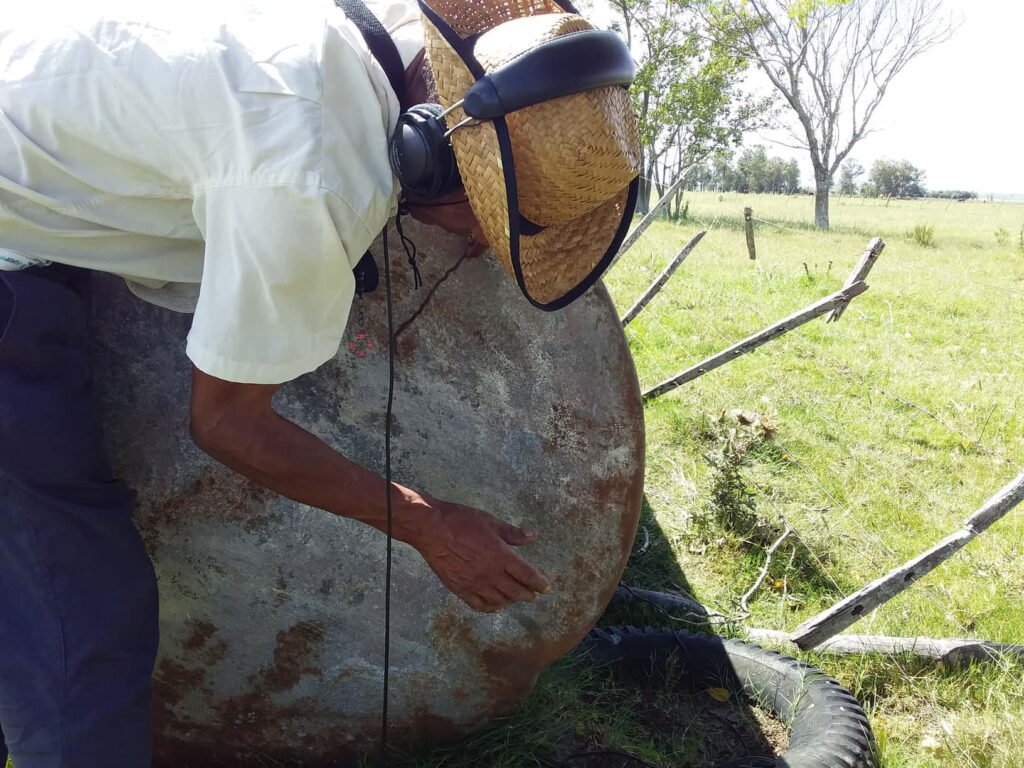
Using the field record and the interview as a tool, they reconstruct the work in the Curtina campaign and other rural areas of Tacuarembó, proposing the Horse as the main actor.

With a precise work of territory, sound recording and research, both highlight the work of the animals and the importance of the equine within the social nucleus in rural areas. An environment that still resists certain insolent outbursts of the uncertain modernity, highlighting and rescuing the role of this particular and necessary actor.

RADIOBALLO, una Radio a Caballo (a Radio on Horseback), perhaps the original name of the project, is a series of 3 episodes broadcast in 2022 in NOISE is the Message (Argentina), mutates to become a testimony of 10 passages that predispose to its Attentive LISTENING in a necessary and profound way without prejudices, as an urgent and immediate reflexive portrait in response to the vacuous immediacy of networks and mobile phones.


CREDITS

Idea, Production: Ana Rodríguez, Robert Da Silva.
Artistic and Associate Producer: Franco Falistoco.
Research: Ana Rodríguez, Robert Da Silva.
Guitar: Enrique Rodríguez Viera.
Mix: Ana Rodríguez.
ReCut + Binaural Remix: Franco Falistoco.


Mastering: CALATHEA experimenta.
URUGUAY/Argentina — 2023
////////////////////
CALATHEA experimenta ©️
experimenta@calathea.ar


El AÑO del Conejo (The YEAR of the Rabbit)

“In Mexico I came across a book and a stone, on these two elements found traces of a very complex country”
This is a job that has as a starting point at the exploration of the concept of time from the Nahuatl, native people from central Mexico.

For Laurette Séjourné & Esperanza Rascón.

All parts of “The Year of the Rabbit” are based on the book “The Náhuatl thought encrypted in the calendars” of Laurette Séjourné.

Tracks:
I. Año 1 Caña – Ce Acatl
II. Año 1 Pedernal – Ce Tecpatl
III. Año 1 Casa – Ce Calli

Interview: Esperanza Rascón.
Sound Objects:
-Wires
-Braches from trees.
-Well modified.
-Stones.
-Virtual piano.

No conventional instruments were used on this piece.

All sounds are produced with sound objects modified through computer.
Year: 2010.

Selection to the Radiophonic Creation Day 2011, France.


CREDITS

This work that joins the CALATHEA Experimenta catalogue has been remastered from its original wav file.

First published in 2009, contained in various repositories under CC-CL licenses and always distributed in lossy audio formats.

The mastering process was assisted by the composer herself.

Mastering: CALATHEA Experimenta
experimenta@calathea.ar


PLEYADE

Pleyade is a word that comes from Latin for a group of people who are outstanding in an activity that is usually artistic. In Greek mythology, Las Pléyades were seven sisters who metamorphosed into doves and then became stars. The constellation bearing this name is also known as the Seven Sisters or the Seven Goats. The name Pléyades also refers to a group of seven Alexandrian tragic poets of the 4th-3rd centuries BC and in France, during the Renaissance, to another group of prominent poets.

Now, Pléyade is also this album that compiles acousmatic and electroacoustic works, a sound poem and soundscapes created with different composition and elaboration techniques. All of them are the result of creative processes carried out by their authors and accompanied in the space of the Taller de Música y Arte Sonoro directed by Pablo Bas, which are here embodied in works that, like spiralling circles, we hope will be fed back to the public who listen to them.

Pablo Bas.


CREDITS:

Mastering: it was carried out in two stages. The first part in Pablo Bas’ studio and then in the Laboratorio de Investigación y Producción Musical del Centro Cultural Recoleta [LIPM CCR] with Gabriel Lucena as technician and the support of FMyT [Fundación Música y Tecnología].

Cover image: Francisco Bas.


SHAUROBOK HYDROMZONO

Shaurobok Hydromzono is the product of an intense work of essays on deep listening to spoken radio, a trial of rights and wrongs to build 4 radio pieces.

Cross-talk and frequency drift strike a chord in this work. The intensive use of cassette tape in the structure and creation of his own compilations became his own works. And in connection with loops and raw editing and frequency losses, creating a sonic organic.


CREDITS

Composed, produced and performed by Shaun Robert.
Mastering: CALATHEA Experimenta
www.calathea.ar
experimenta@calathea.ar


DIPTYCH


DÍPTICO by Jorge Gómez A. is composed of two works, MINOTAURO en Red, on an imaginative variation of the anthropomorphic/mythological figure of the Minotaur in the coetaneity and Paseo de ABEJORRO, radioart from the sounds of the bumblebee deconstructed in an imaginative journey through soundscapes intervened in material abstraction.


CREDITS:

Composed, produced and arranged by Jorge Alberto Gómez Aponte.
Mastering: CALATHEA Experimenta
www.calathea.ar
experimenta@calathea.ar


NOISCAPES


The pandemic atmosphere is palpable, with the mask covering the mouth as a stumbling block and a new variant of the virus as a shadow in the air.

And in this being able/not being able to go out with peace of mind, Noiscapes, Franco Falistoco’s first work and the first reference of his nascent label, Bolinga Everest, appears as a double invitation: to travel without leaving home or, indeed, to go for a ride with his sonic company in tow.

It is striking, coming as it does from the other side of the Andes (Rosario-ARG, to be precise), that the first voices we hear are Chilean, apparently from street musicians devoted to that hard rock of the late 60s and early 70s that is still alive in the hearts and players of various streaming platforms and even open radio stations, such as our local Futuro (which, with that name, embodies a great paradox).

Listening to this series of soundscapes —or noisescapes, as Franco playfully calls them— can be done in a continuous or a piecemeal way without major inconveniences. If we opt for the former, we accompany him on a walk through Viña del Mar, moving from the sound generated by humans to the expression of the water and the beach. After a while, hard rock returns, refusing to die, like the composer Edgar Varese and, later, Frank Zappa.

Then we move from the sea to the park, with the music reappearing, this time acoustic and with a different frame, covered by voices, motors and birds, intertwining and maintaining the expressive sonorous pulse. After a while, we lose sight of details and sources: the motorised vehicles and ambient noise change into colours and timbres; the silhouettes and contours dissolve, becoming paintings or animations, if that’s how we want to conceive them. Or rhythms, if we prefer this experimental perspective or disposition.

Such synaesthesia can provoke our sensorium in a very similar way to some of ASMR’s videos, which are presented in an increasingly better audiovisual and thematically more formulaic way. Now we leave the park to return to the water, with a different rhythm and environment: there is also music, human voices and birds that make themselves heard without much inconvenience, which makes me think of the effort that the latter have had to make to distinguish themselves in the city.

Thus, the 30 minutes of NOISCAPES fly by. Just like the extension he proposed to me for this review. “With 30 lines I am the happiest man in the world,” was the invitation. I hope I have followed his example. And may brevity be an impulse to return to the source, to be happy, again and again.

Gerardo Figueroa Rodríguez.
Maipú, Santiago de Chile, end 2021, beginning 2022.


CREDITOS:

Integral Production: Franco Falistoco.
Tape Edition: Bolinga Everest (bolingaeverestrecords.bandcamp.com)
Original Cover Design: Pablo Picco.
Text: Gerardo Figueroa Rodríguez.
Digital Edition: CALATHEA Experimenta.
Mastering: CALATHEA Experimenta.
www.calathea.ar
experimenta@calathea.ar


The Deaths of Hippasus of Metapontum


Hippasus of Metapontus was a pre-Socratic philosopher who is credited with the construction of the dodecahedron as an approximation to a sphere and with the discovery of incommensurability, which in the philosophy of science is the impossibility of comparing two theories when there is no common theoretical language. If two theories are incommensurable then there is no way to compare them and say which one is correct. In mathematics it is not the impossibility of comparison, but the absence of a common factor that can express it.

Apparently, Hippasus unveiled secrets that should not be revealed “to those who were not worthy to partake of such knowledge” according to the Acousmatists, (The Acousmatists were the custodians of Pythagoras’ teachings and their main concern was that they should be preserved as Pythagoras had handed them down).

Hippasus disregarded the warnings of the Acusmatics and said the wrong things to the wrong people. The result was his expulsion from the community and his subsequent death… Some sources cite that he died by drowning, others that he committed suicide or that Pythagoras killed him. It is not known for certain how he died, what is known is that the Pythagoreans themselves raised a tomb making it clear that, for them, he was already dead.

Here is a small tribute to a philosopher of whom little is said and who spoke out at the most inopportune moments.

If something Hippasus left us, honestly, it was not the discovery of the dodecahedron or incommensurability, it is that bitter taste we have when we read history, it is the certainty that Pythagoras was surely very wrong and that most of our beliefs are based on those mistakes. We know little or nothing of the many Hippos who must have existed and who surely had a tomb named after him before his death.

From this corner of the world, in this age of repeated misunderstandings and insurmountable blindness, I propose two different versions of his own death to Hippiasus of Metapontum so that he may finally rest in peace.

Thank you Hippasus for discovering the incommensurability of things. Without it we would not have the capacity to know that another world is possible just because not everything is measurable and quantifiable.

Sol Rezza — 2009


Credits:

This work, which joins the CALATHEA Experimenta catalogue, has been remastered from its original wav file.

First published in 2009, contained in several repositories under CC-CL licenses and always distributed in lossy audio formats.

For the first time it is released in high quality digital format. The mastering process was assisted by the composer herself.
Mastering for platforms by CALATHEA Experimenta.


Shorts for RADIO

Dedicated to the archive.org project because everything we do once done ceases to belong to us, time knows no copyrights.

“Shorts for RADIO” is an experimental radio series that lasts approximately 12 minutes. It is the result of a research based on sound archives dating from the 20’s to the 60’s, from different parts of the world that can be found in archive.org under the public domain.

“Shorts for RADIO” was born at the end of 2011 with the idea of creating a small virtual radio fragment, a piece of experimental radio that collects sound particles and texts that at some point have been transmitted through a media such as radio or television. From these sound fragments, I tried to recreate a new discourse, a play on words, a transformation of language, a wink between sound composition and radio style, an ethereal sigh in a convulsed virtual world where radio mutates and languages and meanings take on different meanings.

Radio is a medium that takes the form of what it represents, a voice, a sound behind a black curtain, solitude in the middle of the night, a gaze without eyes. Something that is beyond our reach, but that is there. Something we understand beyond the language of words, a language that extends, through sounds.

Recommended listening at night, with headphones.

Year: 2012
Produced by: Sol Rezza 


Créditos:

Original Cover Design: Daniel Iván.
Re-design: CALATHEA Experimenta.

Re-Release 2012-2023.
Mastering: CALATHEA Experimenta.


SPIT

Paradox: Made from soundscapes of a lawnmower, a barking dog, sounds of lakes, piers and rivers in different locations.
All of them modified through a computer DAW with virtual instruments without MIDI connection.

Aerangis Confusa: Made from the soundscape of lakes and piers, modified through a computer DAW.

Revolution as a Loop: Related to the soundscape of lakes and storms. Modified through a computer DAW with virtual instruments without MIDI connection.

The Cat: Made from soundscapes of crickets, lakes, storms and wharfs. Modified through a computer DAW with virtual instruments without MIDI connection.

Putting the parts together results in a final piece with a duration of 47 minutes.
It is recommended to listen to it as a journey: with headphones if possible, and in a comfortable place, with the lighting you like the most.

Sol Rezza
12 August 2011.


Features of the Edition

SPIT: Paradox of Aerangis, the first and second parts, merged into one name.

SPIT: Revolution as a Cat, is the third and fourth parts, merged into a single name.

SPIT, which becomes part of the CALATHEA Experimenta catalogue, has been remastered from its original wav file.


Credits:

This work, which joins the CALATHEA Experimenta catalogue, has been remastered from its original wav file.

First released in 2011 by the label ACUSTRONICA, contained in various repositories under CC-CL licenses and always distributed in lossy audio formats.

For the first time it is released in high quality digital format.
The mastering process was assisted by the composer herself.
Mastering for platforms by CALATHEA Experimenta.